

31
Jul
Skin Cancer Reconstruction After Mohs Surgery: What Fairfield County Patients Should Know
Patients throughout Fairfield County who have just learned they need Mohs surgery for a skin cancer diagnosis often have not yet thought through the reconstructive step that follows removal, focused understandably on the cancer diagnosis itself. Dr. Laurence Kirwan's skin cancer surgery and reconstruction practice specifically addresses this next step, and understanding what it involves in advance can ease some of the uncertainty patients face during this process.
Understanding Mohs Surgery and Why Reconstruction Follows It
Mohs surgery is a precise, layer-by-layer technique used to remove certain skin cancers, most commonly basal cell and squamous cell carcinoma, particularly when the cancer is located near sensitive structures like the eyes, nose, lips, or ears where preserving as much healthy surrounding tissue as possible is especially important. During Mohs surgery, a dermatologist or Mohs surgeon removes the cancer in thin layers, examining each layer under a microscope immediately to confirm all cancerous cells have been removed before closing the site.
Because this technique prioritizes complete cancer removal over minimizing the resulting defect, the wound left behind after Mohs surgery can range from relatively small to quite significant, particularly when the cancer required multiple layers of removal. This is where reconstructive surgery becomes necessary, restoring both the appearance and function of the affected area once the cancer itself has been fully cleared.
Why Reconstruction Requires a Different Skill Set Than Cancer Removal
Mohs surgeons and dermatologists are specifically trained in the precise removal and microscopic examination process that defines Mohs technique, but reconstructing the resulting defect, particularly in cosmetically and functionally sensitive areas like the face, requires the specific training a plastic surgeon brings. Dr. Kirwan's extensive plastic surgery training, spanning a five-year minimum residency covering the full range of reconstructive techniques, provides the specific skill set needed to restore both appearance and function following Mohs excision, distinct from the removal process itself.
How Reconstruction Timing Works
Reconstruction can be performed on the same day as the Mohs excision or on a separate day, depending on the specific case and scheduling coordination between the Mohs surgeon and Dr. Kirwan. In many cases, patients undergo their Mohs procedure in the morning, and once the Mohs surgeon confirms the cancer has been completely removed, Dr. Kirwan performs the reconstruction the same day, minimizing the time the wound remains open and reducing the number of separate appointments a patient needs to manage.
Principles Guiding Reconstructive Planning
Dr. Kirwan's approach to reconstruction following skin cancer removal follows several core principles. Tissue used to restore the defect should match the surrounding area in thickness and color as closely as possible, since a poor match can create a visibly obvious patch rather than a seamlessly blended result. Reconstruction should avoid pulling or distorting nearby structures, such as the lower eyelid or the edge of the nose, since tension from a poorly planned closure can create secondary functional or cosmetic problems beyond the original defect. Whenever possible, scars are positioned within or parallel to the natural creases and contours of the face, helping the resulting scar blend into these existing lines rather than creating a new, more visible mark.
Common Reconstruction Techniques
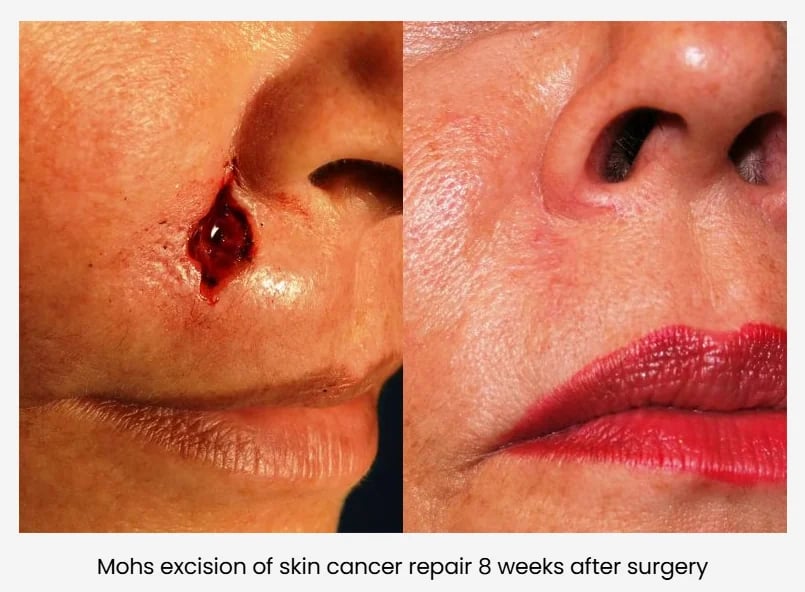
The specific reconstructive approach depends on the size, depth, and location of the defect left behind after Mohs surgery. For smaller defects, simply closing the wound edges together in a carefully planned direction may be sufficient. For larger or more complex defects, a skin flap, moving nearby tissue with its own blood supply into the defect, is often necessary to provide adequate coverage while maintaining healthy blood flow to the reconstructed area. In some cases, a skin graft, using tissue harvested from another part of the body, may be the most appropriate option, particularly for larger defects where nearby tissue is not sufficient to cover the area without creating significant tension or distortion.
Dr. Kirwan selects the specific technique based on a careful evaluation of the defect's characteristics and location, rather than defaulting to a single standardized approach for every case.
Reconstruction Near Sensitive Facial Structures
Defects located near the eyes, nose, lips, and ears require particularly careful reconstructive planning, since these areas combine cosmetic sensitivity with genuine functional importance. A poorly planned reconstruction near the lower eyelid, for example, can pull the eyelid down or outward, a condition called ectropion, potentially affecting both appearance and the eye's ability to close and stay adequately lubricated. Dr. Kirwan's approach specifically accounts for these functional considerations, not just the cosmetic appearance of the reconstructed area, when planning surgery in these more delicate anatomical zones.
What to Expect During the Reconstruction Procedure
Reconstructive surgery following Mohs excision is typically performed under local anesthesia in an office setting for more straightforward cases, though more complex reconstructions may be performed under sedation or general anesthesia in a hospital setting depending on the extent and location of the defect. The procedure itself generally takes anywhere from thirty minutes to a couple of hours, depending on the complexity of the reconstruction required.
Recovery After Reconstructive Surgery
Recovery timelines vary considerably depending on the specific reconstructive technique used and the location of the defect. Simple closures generally involve a relatively brief recovery, with sutures typically removed within a week to ten days for facial incisions. More complex flap or graft reconstructions may require a somewhat longer recovery period, with continued monitoring to confirm the reconstructed tissue is receiving adequate blood supply and healing appropriately.
Scars from skin cancer reconstruction typically follow a similar maturation pattern to other surgical scars, appearing more red or raised initially before gradually fading toward a lighter, flatter appearance over six to eighteen months.
Why Choosing a Plastic Surgeon for This Step Matters
Not every patient realizes they have a choice in who performs their reconstruction following Mohs surgery, sometimes assuming the Mohs surgeon or dermatologist will handle this step as well. Patients are encouraged to specifically ask about their reconstruction options and to consider a plastic surgeon with dedicated training in facial reconstruction, particularly for defects located in cosmetically or functionally sensitive areas, since the reconstructive outcome can meaningfully affect both appearance and function for years to come.
Dr. Kirwan's Broader Reconstructive Experience
Beyond skin cancer reconstruction specifically, Dr. Kirwan's decades of surgical experience, spanning general surgery training across multiple countries before his plastic surgery residency, provide a broad reconstructive foundation relevant to the varied and sometimes unpredictable defects that skin cancer removal can create. This breadth of experience supports confident, individualized decision-making across the wide range of specific scenarios that skin cancer reconstruction can present.
Coordinating Care Between Your Mohs Surgeon and Dr. Kirwan
Patients preparing for Mohs surgery who want Dr. Kirwan to handle their reconstruction should discuss this coordination in advance with both their Mohs surgeon or dermatologist and Dr. Kirwan's office, allowing for appropriate scheduling coordination, particularly if same-day reconstruction is being planned. This advance coordination helps ensure a smoother overall experience from cancer removal through reconstruction.
How Dr. Kirwan Coordinates With Local Dermatologists and Mohs Surgeons
Given the frequency with which skin cancer reconstruction requires coordination between multiple providers, Dr. Kirwan has established working relationships with dermatologists and Mohs surgeons throughout Fairfield County, streamlining the referral and scheduling process for patients navigating this two-step treatment pathway. Patients whose dermatologist does not already have an established referral relationship with a reconstructive surgeon are welcome to independently reach out to Dr. Kirwan's office to establish this coordination themselves, ensuring their reconstructive care is handled by a surgeon of their own choosing.
Why Some Patients Need Multiple Reconstruction Stages
For particularly large or complex defects, a single reconstructive procedure may not achieve the optimal final result, and Dr. Kirwan may recommend a staged approach, performing an initial reconstruction to close the defect safely, followed by a secondary revision procedure some months later to further refine the scar or address any remaining asymmetry once the initial healing has fully settled. This staged approach is not a sign that the initial reconstruction was inadequate, but rather a deliberate strategy for achieving the best possible long-term cosmetic and functional outcome in particularly challenging cases.
The Psychological Dimension of Facial Skin Cancer Treatment
Patients diagnosed with skin cancer on a visible facial area often experience genuine anxiety not just about the cancer diagnosis itself but about how the resulting defect and subsequent reconstruction will affect their appearance. Dr. Kirwan approaches these consultations with particular sensitivity to this emotional dimension, taking time to explain the reconstructive plan clearly and to set realistic, reassuring expectations about the eventual cosmetic outcome, recognizing that this reassurance is an important part of supporting patients through what can be a stressful diagnosis and treatment process.
Long-Term Skin Cancer Prevention After Reconstruction
Following successful treatment and reconstruction, patients should understand that having had one skin cancer increases the likelihood of developing additional skin cancers in the future, making ongoing dermatological surveillance and diligent sun protection particularly important going forward. Dr. Kirwan often discusses this long-term prevention perspective with patients during their recovery, reinforcing the importance of continued skin checks and sun safety as part of their overall long-term health strategy beyond the immediate reconstruction itself.
How Reconstruction Planning Differs for Recurrent Skin Cancers
Patients facing a recurrent skin cancer in an area that has been previously treated present unique reconstructive challenges, since the tissue in this area may already carry scarring or altered blood supply from the original treatment. Dr. Kirwan's evaluation of recurrent cases specifically accounts for this prior surgical history, sometimes requiring a different reconstructive approach than would be used for a first-time defect in unaltered tissue, given the additional complexity previously treated tissue can introduce.
Understanding the Difference Between Basal Cell and Squamous Cell Reconstruction Needs
While both basal cell and squamous cell carcinoma are commonly treated with Mohs surgery, squamous cell carcinoma carries a somewhat higher risk of spreading to nearby lymph nodes in certain cases, which can occasionally affect the broader treatment and monitoring plan beyond the immediate reconstruction itself. Dr. Kirwan coordinates with a patient's broader care team, including their dermatologist and, when relevant, an oncologist, to ensure the reconstructive plan fits appropriately within this broader treatment context rather than being planned in isolation from other relevant medical considerations.
What Makes Reconstruction Near the Nose Particularly Challenging
The nose presents unique reconstructive challenges given its complex three-dimensional shape, the need to maintain symmetry with the opposite side, and its central, highly visible position on the face. Defects on the nose sometimes require more sophisticated flap techniques, borrowing tissue from the forehead or cheek in more extensive cases, to achieve an adequate reconstruction that maintains both nasal function and a natural appearance. Dr. Kirwan's experience with these more complex nasal reconstructions reflects the broader surgical training and judgment this particularly demanding anatomical area requires.
Preparing Emotionally and Practically for Your Reconstruction Appointment
Patients preparing for their reconstruction appointment benefit from arranging for a ride home if any sedation will be used, wearing comfortable clothing that does not need to be pulled over the head if the defect is on the face, and bringing a support person if they would find that reassuring given the emotional weight a cancer diagnosis and subsequent treatment can carry, even when the reconstructive procedure itself is relatively straightforward.
Why Patients Should Feel Empowered to Ask Questions Throughout the Process
Given how much coordination is involved between a Mohs surgeon or dermatologist and Dr. Kirwan for reconstructive care, patients sometimes feel hesitant to ask detailed questions of either provider, unsure whose responsibility a specific question falls under. Dr. Kirwan's office welcomes questions about any aspect of the reconstructive process, whether that means clarifying details about the Mohs procedure itself or the specific reconstructive plan, ensuring patients never feel they need to navigate this two-step treatment process without adequate support and information.
The Value of Reviewing Reconstruction Results From Similar Cases
Patients facing a reconstruction in a specific facial area, particularly one as visible and functionally important as the nose, eyes, or lips, benefit from asking to see examples of Dr. Kirwan's prior reconstructive work in that same specific area, helping set realistic expectations for their own outcome based on genuinely comparable cases rather than a general sense of what reconstructive surgery can achieve.
Taking the Next Step
If you have been diagnosed with a skin cancer requiring Mohs surgery and want to discuss your reconstructive options in Fairfield County, contact Dr. Kirwan's office today.
Frequently Asked Questions
Can reconstruction be performed the same day as my Mohs surgery?
In many cases, yes, once the Mohs surgeon confirms the cancer has been completely removed. This coordination should be discussed in advance between your Mohs surgeon and Dr. Kirwan's office.
Do I have to use the surgeon my dermatologist recommends for reconstruction?
No. Patients can choose their own reconstructive surgeon, and it is worth specifically asking about this option and considering a plastic surgeon with dedicated facial reconstruction training.
Will I have a visible scar after reconstruction?
Some scarring is unavoidable, though Dr. Kirwan plans incisions to follow natural facial creases and contours whenever possible, helping the scar blend in and fade significantly over time.
What techniques are used for skin cancer reconstruction?
Depending on the defect's size and location, techniques range from simple direct closure to skin flaps, which move nearby tissue into the defect, or skin grafts using tissue from another area of the body.
How long does recovery take after reconstruction?
This varies based on the specific technique used, with simple closures healing relatively quickly and more complex flap or graft reconstructions requiring a longer recovery and monitoring period.
Why does reconstruction near the eyes require special care?
Poorly planned reconstruction near the eyelids can pull the eyelid out of position, potentially affecting both appearance and the eye's ability to close properly, making careful, functionally aware planning essential in this area.
Is skin cancer reconstruction covered by insurance?
Reconstruction following medically necessary skin cancer removal is typically covered by insurance, unlike purely elective cosmetic procedures, though patients should confirm specific coverage details with their individual insurance plan.
Call Our Office For More Information
Share this Article
Dr. Laurence Kirwan
Dr. Laurence Kirwan, MD, FRCS, FACS, is an internationally renowned, board-certified plastic surgeon with over 30 years of experience. He trained at Manchester University and completed his Plastic Surgery residency at the University of Missouri. A Fellow of the Royal College of Surgeons and American College of Surgeons, he is a leader in aesthetic surgery, specializing in face, breast, and body procedures. Dr. Kirwan has authored multiple scientific papers and books and served as an instructor in prestigious programs. Recognized by Tatler and Russian Vogue, he practices in Connecticut, where he continues to offer personalized, top-tier care to his patients.