

18
Aug
Capsular Contracture: When It's a Simple Fix and When It Means Explant
If you have noticed one breast feeling firmer than it used to, sitting higher than the other, or looking rounder and less natural than it did in the first year or two after augmentation, you are almost certainly dealing with capsular contracture, and you are almost certainly not the first person to search for this wondering whether it's an emergency, a nuisance, or something that requires surgery.

The honest answer is: it depends on the grade. This article is organized the way an actual clinical evaluation is organized, starting from what you can observe yourself and branching toward what it usually means.
Start Here: What Is Capsular Contracture
Every breast implant, without exception, causes the body to form a thin layer of scar tissue around it. This is a normal, expected, universal response, not a complication. In most patients, this capsule stays soft and thin and is undetectable by touch or sight. Capsular contracture occurs when that scar tissue thickens and tightens, squeezing the implant. It can happen months or many years after the original surgery, and it can occur in one breast without affecting the other, which is often what makes it noticeable in the first place, an asymmetry that wasn't there before.
Surgeons classify capsular contracture using the Baker grading scale, from Grade I to Grade IV. This grading is the entire basis for the "simple fix vs. explant" decision, so it's worth understanding before anything else.
Branch One: Grade I - Soft, Natural-Looking, No Visible Change
If your breast looks the same as it did after your initial recovery and feels soft to the touch, with no visible distortion, you are very likely dealing with Grade I, which is not actually contracture in a clinical sense so much as a normal healed result. There is nothing to treat here. This branch ends without intervention, but it is worth ruling out because so many patients assume any capsule at all means a problem is brewing.
What to do: Nothing urgent. Mention it at your next routine follow-up if you have implants under long-term monitoring, particularly if you're due for an MRI or ultrasound screening per FDA guidance for silicone implants.
Branch Two: Grade II - Slightly Firm, Still Looks Normal
At this stage, the breast may feel a bit firmer than the other side or firmer than it did previously, but visually it still looks acceptable, no obvious distortion, no visible rippling or shifting. This is where most patients first notice something and start researching.
Grade II does not automatically require surgery. Some surgeons will recommend a period of monitoring, particularly if the firmness is mild and stable rather than progressively worsening. There is some evidence that certain non-surgical approaches, such as specific massage protocols or medications like leukotriene inhibitors, may help in early, mild cases, though the evidence base for these is mixed and they are not a guaranteed fix.
What to do: Schedule an evaluation rather than a wait-and-see approach on your own. A surgeon can determine whether this is stable Grade II worth monitoring or early progression toward Grade III, which changes the recommendation significantly.
Branch Three: Grade III - Firm and Visibly Distorted
This is the branch where most patients stop debating and start scheduling. Grade III means the breast is noticeably firm to the touch and there is a visible change in shape, the implant may look rounder than it should, sit higher on the chest, or create a distorted contour compared to the other side. At this point, non-surgical approaches are very unlikely to resolve the problem, because the scar tissue has thickened enough to structurally affect the shape of the breast.
Surgical treatment at Grade III typically involves either a partial or complete capsulectomy, removing the thickened scar tissue, combined with a decision about whether to replace the implant, remove it entirely, or, in appropriate candidates, use techniques like auto-augmentation to restore shape using the patient's own tissue if explant without replacement is the goal.
What to do: Book a consultation specifically framed around capsular contracture treatment, not a general check-up, so the surgeon has time to properly examine and discuss surgical options.
Branch Four: Grade IV - Firm, Distorted, and Painful
Grade IV includes everything in Grade III plus pain, whether that's tenderness, aching, or discomfort during normal movement or when lying on that side. This grade nearly always requires surgical intervention because the tightened capsule is now causing a physical symptom, not just a cosmetic one.
At this stage, the surgical conversation typically covers capsulectomy technique in more depth, including whether an en bloc capsulectomy (removing the capsule as a single, intact unit) is appropriate, which is sometimes recommended specifically in cases involving suspected implant rupture, certain textured implant histories relevant to BIA-ALCL risk, or significant calcification within the capsule.
What to do: Do not delay this evaluation. Pain associated with capsular contracture is a signal worth acting on promptly, both for comfort and because surgical planning tends to be more straightforward before the tissue changes further.
How Long Contracture Takes to Develop, and Why That Timeline Matters
One detail that trips up many patients is the assumption that if their implants felt fine for the first several years, capsular contracture is essentially ruled out going forward. This isn't accurate. While a meaningful proportion of contracture cases do present within the first one to two years after augmentation, often related to subclinical infection or a hematoma in the early postoperative period, contracture can also develop, or worsen from a previously stable Grade I or II, many years later, sometimes a decade or more after the original surgery, without any clear triggering event.
This matters practically because it means capsular contracture isn't a risk you graduate out of after a certain number of trouble-free years. It's a reason long-term implant patients benefit from periodic self-checks for firmness and shape change, not just the imaging screenings recommended for silicone implant integrity, and a reason that a sudden change noticed after many stable years should still be evaluated rather than dismissed as unlikely given how long things have been fine.
What the Research Says About Prevention at the Time of Original Surgery
For patients who haven't yet had augmentation, or who are planning revision surgery and want to minimize the odds of facing this issue again, it's worth understanding what surgical factors are associated with lower contracture rates in the research literature, since this information shapes how a thoughtful surgeon approaches the original procedure, not just how they respond after contracture has already developed.
Meticulous attention to minimizing bacterial contamination during surgery, sometimes through specific handling protocols that limit skin contact with the implant surface, has been associated with lower contracture rates in multiple studies. Submuscular or dual-plane implant placement, positioning the implant partially or fully beneath the chest muscle rather than directly above it, has also been associated with lower contracture rates compared to purely subglandular placement in much of the published literature, though placement decisions involve multiple factors beyond contracture risk alone, including a patient's existing tissue thickness and aesthetic goals. Careful management of bleeding during surgery to minimize hematoma risk, and appropriate use of drains in certain cases, are additional technical factors associated with better long-term capsule outcomes.
None of these factors guarantee prevention, since, as discussed above, individual scarring tendency and genetics play a role that surgical technique cannot fully control. But they represent the technical, evidence-based side of contracture risk reduction, as distinct from the various non-surgical products and protocols marketed to patients with much weaker evidence behind them.
The Question Underneath All Four Branches: Replace or Remove?
Regardless of grade, once surgery is on the table, patients face the decision that started this whole search in the first place: do you replace the implant with a new one, or do you take this opportunity to go without? This is where the earlier fear comes back into focus, that removing the implant will leave the breast looking worse than it did with a hardened capsule.
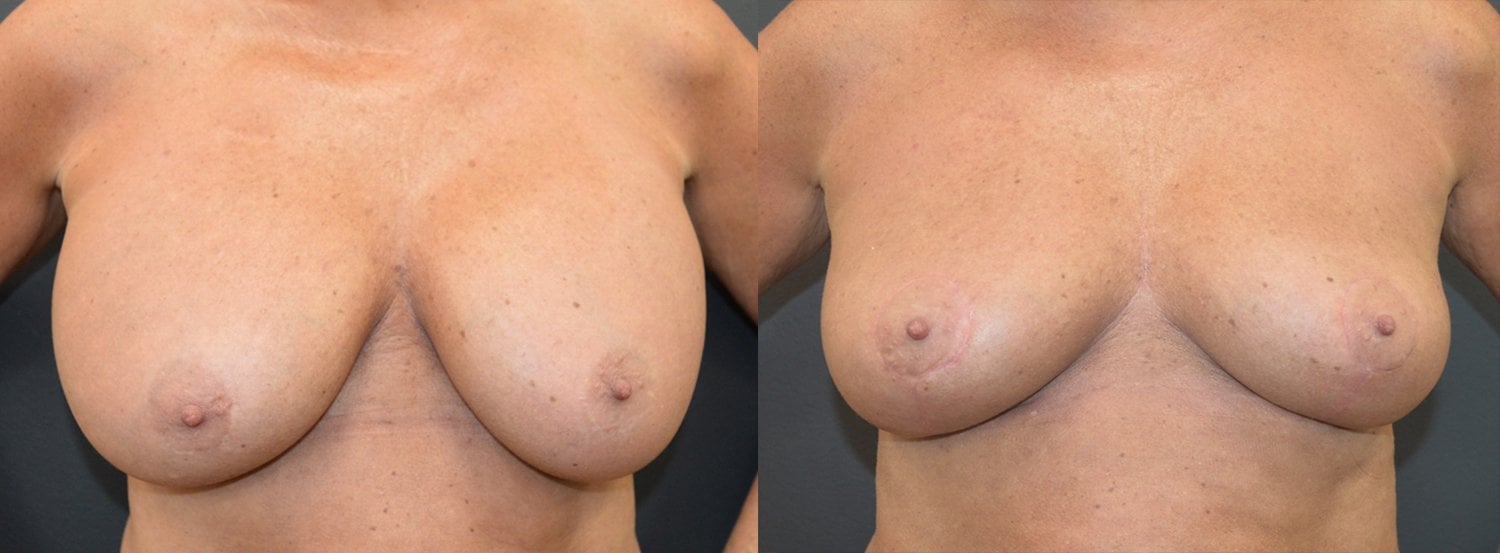
For patients who have decided they are done with implants altogether, whether due to contracture recurrence, BII concerns, or simply personal preference after years of maintenance, capsulectomy can be combined with a reshaping technique such as auto-augmentation, which uses the patient's own tissue to rebuild upper pole fullness rather than leaving a deflated result. This is a well-documented approach with published outcomes data, not an improvised solution, and it's worth asking any surgeon you consult with directly whether they have experience specifically with capsulectomy combined with natural tissue reshaping, rather than capsulectomy alone.
What Causes Capsular Contracture in the First Place
Understanding why contracture happens helps explain why it can appear suddenly, years after an uneventful augmentation, rather than showing up predictably in the first year. Researchers have proposed several contributing factors, and in most patients it's likely a combination rather than a single cause. Subclinical infection, a low-grade bacterial presence around the implant that doesn't produce obvious signs of infection but triggers an ongoing low-level inflammatory response, is one of the more consistently supported theories, which is part of why meticulous surgical technique and infection prevention protocols during the original surgery matter so much for long-term outcomes, not just short-term healing.
Hematoma or seroma, meaning blood or fluid collection around the implant in the early postoperative period, is another recognized risk factor, since these collections can promote scar tissue formation as they resolve. Implant surface type has historically played a role as well, with textured surfaces behaving differently than smooth surfaces in terms of contracture rates, though this conversation has become more complex in recent years given the separate concerns around textured implants and BIA-ALCL discussed elsewhere in our content.
Genetics and individual scarring tendency also appear to play a role, which is part of why two patients who underwent identical procedures on the same day, with the same surgeon and the same implants, can have completely different outcomes years later, one with a soft, stable result and one with progressive Grade III contracture. This variability is frustrating for patients looking for a clear, controllable explanation, but it's an honest description of what's actually understood about the condition.
Can Capsular Contracture Be Prevented in a New Implant After Revision?
If you're facing revision surgery for contracture, a natural next question is whether the new implant, or the reshaped result if you're pursuing auto-augmentation instead, is likely to develop the same problem again. There is no guaranteed way to prevent recurrence, but several surgical strategies are associated with lower recurrence rates and are worth discussing directly with your surgeon.
Complete rather than partial capsulectomy, removing the entire scar capsule rather than leaving a portion behind, is generally associated with better outcomes when contracture is the reason for revision, since any remaining capsule tissue can theoretically continue the same inflammatory process that caused the original contracture. Changing the implant pocket position, for example moving from a position on top of the muscle to a position underneath it, or vice versa depending on the original placement, is sometimes recommended as part of a revision plan specifically to give the tissue a fresh plane without the prior scar tissue relationship. The use of specific surgical techniques to minimize bacterial contamination during the revision procedure, sometimes called a "no-touch" technique for implant handling, is also associated with lower contracture recurrence in the research literature.
For patients pursuing auto-augmentation rather than a new implant, this entire prevention conversation becomes largely moot for the treated breast, since there is no implant present to develop contracture around going forward. This is, for some patients, one of the more compelling reasons to consider reshaping with their own tissue rather than replacement, not just the philosophical preference for a natural result, but the practical elimination of a recurring problem they've already experienced once.
What a Physical Exam for Capsular Contracture Actually Involves
Patients sometimes arrive at a consultation unsure what to expect from the exam itself, which can make an already uncomfortable topic feel more intimidating than it needs to be. A capsular contracture evaluation typically involves the surgeon examining both breasts for firmness, symmetry, and mobility, meaning how easily the implant moves within its pocket when gentle pressure is applied, which is often more informative than firmness alone in distinguishing between grades. The surgeon will also look at breast shape from multiple angles, since some contracture-related distortion, particularly the rounding or upward displacement associated with Grade III, is more visible from certain positions than others.
Depending on findings, imaging may be recommended as a next step, particularly if there's any concern about implant integrity underlying the contracture or if the exam findings are ambiguous between grades. This is a normal part of a thorough evaluation, not an escalation that should cause alarm.
Why Grading Yourself Only Gets You So Far
It's worth being direct about the limits of a self-assessment. Firmness and visible distortion can be subtle in early Grade II and easy to underestimate, and pain in Grade IV cases can sometimes be masked by pain tolerance or attributed to something else entirely, like a pulled muscle. The branches above are meant to help you understand where you likely stand and what questions to ask, not to replace a physical exam. A surgeon examining you in person, ideally one with specific experience in both capsulectomy and revision breast surgery, will confirm the grade and build a plan around your anatomy, your implant history, and your goals for what comes next.
Dr. Kirwan approaches capsular contracture evaluation with this same focus on grading the condition first, then tailoring the surgical plan to the patient's anatomy, implant history, and goals - whether that means monitoring, capsulectomy with implant replacement, or explantation with natural tissue reshaping.
The Emotional Side of a Contracture Diagnosis, and Why It's Worth Naming
Beyond the clinical grading and surgical options, it's worth acknowledging something that gets left out of most medical descriptions of capsular contracture: the emotional weight of realizing a result you were happy with, sometimes for many years, is changing in a way you didn't choose and can't reverse on your own. Patients often describe a mix of frustration, self-doubt about whether they did something to cause it, and anxiety about facing another surgery when they thought that chapter of their life was closed.
None of this is a sign of anything being wrong with your reaction. It's a proportionate response to a genuinely disruptive situation, and it's worth raising directly with your surgical team rather than minimizing it as "just cosmetic." A surgeon who takes the time to walk through your specific grade, your specific options, and a realistic timeline for resolution is addressing both the clinical and the emotional dimensions of what you're dealing with, and that combination of clarity and care is exactly what makes the difference between feeling like a passive patient in someone else's process and feeling like an informed participant in your own care.
Frequently Asked Questions
Can capsular contracture happen years after my original surgery, even if everything was fine at first?
Yes. Contracture can develop at any point after augmentation, sometimes many years later, and can occur in one breast without affecting the other.
Is Grade II capsular contracture an emergency?
No, but it should be evaluated rather than monitored on your own, since it can be stable or progressive, and only an exam can distinguish between the two.
Do I have to replace my implant if I need capsulectomy?
No. Capsulectomy can be combined with implant replacement, complete removal, or removal paired with a natural tissue reshaping technique like auto-augmentation, depending on your goals.
What is en bloc capsulectomy and when is it used?
It refers to removing the capsule as one intact piece rather than in fragments, and is sometimes recommended in cases involving suspected rupture, certain implant surface types, or capsule calcification.
Can massage or medication fix capsular contracture without surgery?
In mild, early Grade II cases, some approaches may help, but evidence is limited and inconsistent. Grade III and IV contracture generally require surgical treatment.
How do I know if my pain is from capsular contracture or something else?
Any new pain associated with an existing implant warrants an evaluation. While Grade IV contracture commonly causes pain, a surgeon needs to rule out other causes such as infection or rupture.
Call Our Office For More Information
Share this Article

Dr. Laurence Kirwan
Dr. Laurence Kirwan, MD, FRCS, FACS, is an internationally renowned, board-certified plastic surgeon with over 30 years of experience. He trained at Manchester University and completed his Plastic Surgery residency at the University of Missouri. A Fellow of the Royal College of Surgeons and American College of Surgeons, he is a leader in aesthetic surgery, specializing in face, breast, and body procedures. Dr. Kirwan has authored multiple scientific papers and books and served as an instructor in prestigious programs. Recognized by Tatler and Russian Vogue, he practices in Connecticut, where he continues to offer personalized, top-tier care to his patients.