

18
Aug
Thigh Lift After Weight Loss: The Anchor Thighplasty Explained
Losing a significant amount of weight, whether through lifestyle change, bariatric surgery, or GLP-1 medications, changes the shape of your body in ways that exercise and time alone often cannot fix. Nowhere is this more frustrating than the thighs, where loose, hanging skin can persist for years after the weight itself is gone. Patients researching solutions run into a lot of conflicting, oversimplified information. This article works through the most common misconceptions one at a time.
Myth: "Liposuction Will Fix Loose Thigh Skin"
This is probably the single most common misunderstanding patients bring into a consultation. Liposuction removes fat. It does not remove skin, and it does very little to tighten skin that has already lost its elasticity from significant weight loss or age.
Fact: Once skin has been stretched past a certain point and has lost its collagen and elastic fiber structure, particularly after losing 50, 100, or more pounds, it will not meaningfully retract on its own or in response to fat removal alone. If the primary complaint is loose, hanging, or crepey skin rather than excess fat, liposuction alone will not solve the problem, and non-invasive body contouring options face the same limitation, since neither removes or tightens skin that has already lost its elasticity . This is why an experienced surgeon will ask specifically what bothers you about your thighs, fat, skin, or both, before recommending a procedure, and why a thigh lift, not liposuction, is usually the correct answer for post-weight-loss skin laxity.
Myth: "A Thigh Lift Only Addresses the Inner Thigh"
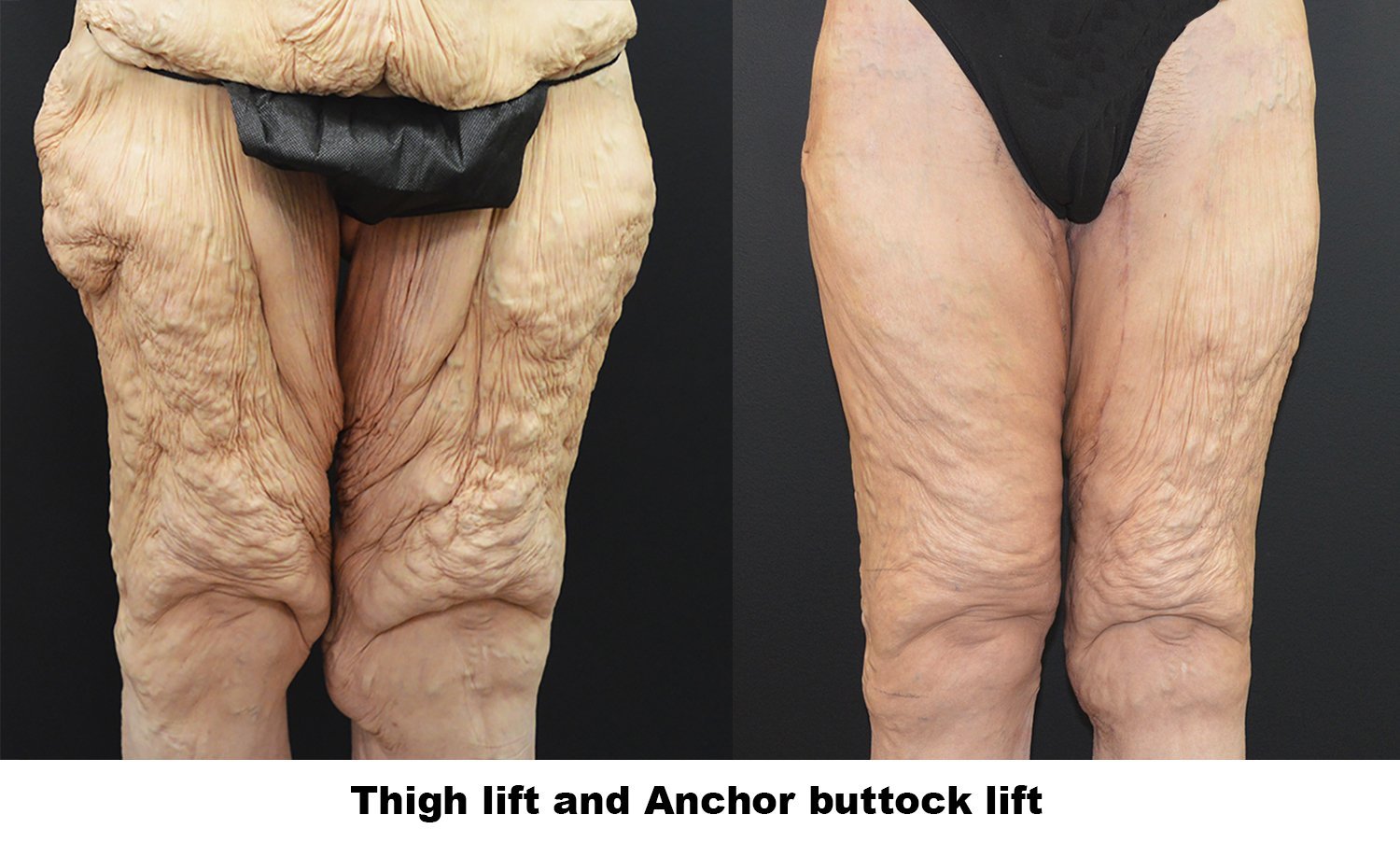
Many patients assume "thigh lift" refers to a single, standard incision along the inner groin crease, because that is the version most commonly described online. This version, a medial thighplasty, is real and appropriate for some patients, but it is not the only option, and for patients with circumferential excess, meaning loose skin that wraps around the front, sides, and back of the thigh in addition to the inner thigh, it is often insufficient on its own.
Fact: For patients with more extensive skin excess extending around the thigh, a more comprehensive approach called an anchor thighplasty is often required. This technique combines a horizontal incision along the groin crease with a vertical incision running down the inner thigh, forming an anchor-like shape, which allows the surgeon to remove excess skin circumferentially rather than only along a single line. It is a more extensive procedure with a correspondingly longer scar, but for the right candidate, it is the only technique that actually addresses the full extent of the problem rather than a portion of it.
Myth: "More Incision Length Always Means a Worse Scar Outcome"
It's intuitive to assume that a shorter scar is automatically the better cosmetic outcome, and marketing for "minimal scar" procedures reinforces this assumption constantly.
Fact: Scar length is not the only variable that determines how a scar looks or how satisfied a patient is with their result. A shorter incision that leaves behind a rope of loose, hanging skin along the thigh solves nothing and often looks worse in clothing and swimwear than a longer, well-placed incision that fully addresses the excess. The relevant question isn't "which technique has the shortest scar," it's "which technique actually removes the tissue causing my main complaint, positioned in a place that heals well and is easy to conceal." An anchor thighplasty incision is designed to sit along natural creases and the inner thigh line specifically because that placement heals more predictably and is easier to hide in typical clothing than a scar placed to minimize length at the expense of position.
Myth: "This Procedure Is Basically the Same as a Tummy Tuck"
Patients often lump body contouring after weight loss into one mental category, assuming a thigh lift is essentially "a tummy tuck for the legs" with similar recovery and risk.
Fact: While both are body contouring procedures addressing skin excess after weight loss, thigh lift surgery involves distinct anatomical considerations, including proximity to lymphatic drainage in the groin, which affects swelling and healing time, and a different set of activity restrictions during recovery given the location's involvement in walking and sitting. Recovery from an anchor thighplasty typically involves more restricted mobility in the first one to two weeks than a tummy tuck, since the incisions run through areas directly involved in leg movement, and patients are usually advised to avoid activities that create tension across the inner thigh incision, such as wide-legged sitting or strenuous walking, for a longer initial period. Compression garment use is also more specific to thigh anatomy and is worn for a longer overall duration in most surgical plans.
Myth: "I Should Wait Until I've Reached My Exact Goal Weight"
Many patients delay a consultation because they feel they haven't "finished" losing weight yet, worried that a thigh lift performed too early will need to be redone.
Fact: Surgeons generally recommend waiting until your weight has been stable for a meaningful period, typically several months to a year, rather than waiting for a specific number on the scale. Continued weight fluctuation after a thigh lift can affect the surgical result regardless of what the number was at the time of surgery, but a patient who has stabilized at a healthy, sustainable weight, even if it is not their originally hoped-for number, is generally a better candidate than one who is still actively losing and whose skin envelope will continue to change. This distinction, stability versus a specific target, is worth discussing directly in consultation rather than assuming based on internet advice.
Myth: "Compression Garments Are Just a Formality After Surgery"
Patients sometimes treat post-surgical compression wear as an optional comfort item, something they can skip on days it feels inconvenient or when they're eager to get back into regular clothing.
Fact: Compression garments after an anchor thighplasty play a specific mechanical role in managing swelling and supporting the healing tissue as it settles into its new position, particularly given the thigh's constant involvement in movement, sitting, and weight-bearing throughout the day. Inconsistent compression wear can contribute to prolonged swelling, uneven healing, and in some cases can affect how well the final scar settles, since the skin and underlying tissue are still adjusting to their new configuration for weeks after surgery, not just the first few days. Surgical teams typically provide a specific wear schedule, often continuous wear for the first one to two weeks followed by extended daytime wear for several more weeks, and this schedule is based on the physiology of healing in this specific anatomical area, not a generic recommendation copied from other body contouring procedures.
Myth: "Exercise Is Off Limits for Months, So I Might As Well Wait to Start Any Fitness Routine Until I'm Fully Healed"
Some patients interpret activity restrictions after thigh lift surgery as an all-or-nothing pause, assuming there's no point resuming any physical activity until they're cleared for everything.
Fact: Recovery from an anchor thighplasty is staged, not binary. While strenuous activity, particularly anything involving wide-legged positioning, deep squatting, or significant friction across the inner thigh incisions, is restricted for a meaningful period, many patients are encouraged to begin gentle walking within days of surgery specifically because light movement supports circulation and reduces the risk of blood clots, a real risk after any lower body procedure involving extended time under anesthesia. The specific activities that remain restricted, and for how long, should be laid out explicitly by your surgical team rather than assumed based on general body contouring recovery advice found online, since thigh anatomy and incision placement make this recovery meaningfully different from, for example, recovery after a tummy tuck or arm lift.
Myth: "If I'm Not Losing Weight Through Surgery, Bariatric Surgery Patients and Diet-and-Exercise Patients Need the Exact Same Surgical Approach"
Patients sometimes assume that once significant weight has been lost, regardless of how, the resulting skin excess and the appropriate surgical approach to it are essentially identical from patient to patient.
Fact: While the fundamental problem, excess skin without adequate elasticity to retract, is similar across patients regardless of how the weight was lost, the overall health picture, nutritional status, and healing capacity can differ meaningfully between patients who lost weight through bariatric surgery, GLP-1 medications, or lifestyle changes alone. Bariatric surgery patients in particular may have specific nutritional deficiencies, given the malabsorptive or restrictive nature of many bariatric procedures, that need to be addressed and optimized before body contouring surgery to support proper wound healing. This is why a thorough pre-surgical evaluation includes a detailed history of how the weight loss occurred, not just how much weight was lost, and why blanket comparisons between different patients' recovery experiences found in online forums often don't translate directly to your own situation.
What an Anchor Thighplasty Consultation Actually Involves
For patients who determine, after working through the above, that circumferential skin excess is the primary concern, a consultation for anchor thighplasty typically includes an assessment of skin laxity around the full circumference of the thigh, evaluation of any residual fat that may be addressed simultaneously with liposuction, discussion of incision placement relative to how the patient dresses and their tolerance for a longer scar in exchange for a more complete correction, and a review of overall health factors that affect wound healing and lymphatic function, since these procedures carry a real, if generally low, risk of wound healing complications given their location.
Dr. Kirwan's background includes published work specifically on aesthetic units and zones of adherence relevant to planning incisions in body contouring surgery, meaning incision placement in a procedure like this is approached with attention to how tissue is anatomically anchored to underlying structures, not simply where a scar can be drawn shortest.
What Happens If You Combine This With Other Body Contouring Procedures
Patients who have lost significant weight rarely have a single area of concern, and it's common to be evaluating thigh laxity alongside excess skin on the abdomen, arms, or a general loss of body contour that a body lift addresses more comprehensively. This raises a legitimate question: should an anchor thighplasty be combined with other procedures in one operation, or staged separately?
The honest answer depends heavily on the total extent of surgery being considered, your overall health, and how long you and your surgical team are comfortable keeping you under anesthesia in a single session. Combining a thigh lift with a tummy tuck, for example, is done in some cases, but it significantly increases total operative time and recovery complexity compared to either procedure alone, and it requires careful patient selection based on factors like cardiovascular health and realistic assessment of how much simultaneous swelling and restricted mobility a patient can safely manage during recovery. For patients pursuing multiple significant body contouring procedures after major weight loss, many surgeons recommend a staged approach, addressing the areas of greatest functional or medical concern first, such as a panniculectomy if excess abdominal skin is causing skin breakdown or hygiene issues, before moving to a thigh lift in a separate, later operation.
This staging decision should be made individually in consultation, not assumed based on what a friend or forum post described about their own combined or staged surgery experience, since total health status, the specific combination of procedures under consideration, and personal recovery capacity all vary considerably from patient to patient.
Insurance and the Functional Argument
A detail that surprises some patients is that certain body contouring procedures after massive weight loss can, in specific circumstances, be partially covered by insurance if they can be documented as medically necessary rather than purely cosmetic, most commonly when there is a demonstrated functional problem like recurrent skin breakdown, rashes, or infections in the affected skin folds. This is far more commonly discussed in the context of panniculectomy for abdominal skin than for thigh lift surgery specifically, and coverage criteria, when they exist at all for thigh procedures, tend to be considerably stricter and less consistently applied across insurers.
For most patients, an anchor thighplasty performed primarily for cosmetic improvement and comfort in clothing will be considered an elective, out-of-pocket procedure. It's worth having a direct, early conversation with your surgical practice's office about whether your specific situation includes any documented functional component, such as chronic irritation or skin infections in the affected area, that might be worth discussing with your insurer, rather than assuming coverage is either automatic or entirely out of the question without checking.
Setting Realistic Expectations for Results
An anchor thighplasty will leave a permanent scar. This should be stated plainly rather than minimized, because the tradeoff, a visible scar in exchange for the removal of loose, hanging skin that no amount of exercise or time will resolve, is the actual decision being made. For patients whose quality of life, clothing choices, and comfort in their own body are meaningfully affected by post-weight-loss thigh skin, that tradeoff is very often worth it. For patients with mild, non-circumferential excess, a more limited procedure may achieve a comparable improvement with less scarring, which is exactly why an individualized consultation, not a generic online description, determines the right technique.
The Timeline From Consultation to Final Result
Patients often want a concrete sense of the full timeline, not just the immediate postoperative weeks, when deciding whether to move forward with an anchor thighplasty. A realistic overview looks something like this: an initial consultation and, if needed, a second visit to finalize surgical planning and pre-operative clearance; surgery itself, typically several hours depending on the extent of correction and whether liposuction is combined; the first one to two weeks of significantly restricted mobility and near-continuous compression garment wear; a gradual return to light daily activities over weeks three through six; clearance for most exercise, excluding high-impact or friction-heavy activity, typically around eight weeks, though this varies by individual healing; and a final settled result that continues to refine in subtle ways for six months to a year as swelling fully resolves and scars mature and fade from their initial pink, raised appearance to a flatter, lighter final state.
Understanding this full arc, rather than fixating only on the first two disruptive weeks, helps set realistic expectations for when you'll actually see and feel the result you were picturing when you booked the consultation in the first place.
Frequently Asked Questions
How is an anchor thighplasty different from a standard medial thigh lift?
A standard medial thigh lift addresses only the inner thigh through a single incision along the groin crease. An anchor thighplasty adds a vertical incision down the inner thigh, allowing removal of excess skin around more of the thigh's circumference.
Will liposuction alone fix my loose thigh skin after weight loss?
No. Liposuction removes fat, not skin, and does not meaningfully tighten skin that has lost elasticity from significant weight loss.
How long is recovery after an anchor thighplasty?
Most patients need one to two weeks of significantly restricted mobility and several weeks of continued activity limitations, with compression garment use typically continuing for a number of weeks beyond that.
Do I need to reach my final goal weight before this surgery?
You should be at a stable weight for several months to a year before surgery, but you do not need to have reached a specific target number, as long as your weight is no longer actively fluctuating.
Can liposuction be combined with an anchor thighplasty?
Yes, in appropriate candidates, residual fat can be addressed with liposuction at the same time as the skin excision, depending on the individual case.
Will the scar be visible in shorts or swimwear?
The incisions are placed along the groin crease and inner thigh specifically to minimize visibility in typical clothing, though the vertical component of an anchor thighplasty can be visible in certain swimwear styles, which is worth discussing directly during consultation.
Call Our Office For More Information
Share this Article

Dr. Laurence Kirwan
Dr. Laurence Kirwan, MD, FRCS, FACS, is an internationally renowned, board-certified plastic surgeon with over 30 years of experience. He trained at Manchester University and completed his Plastic Surgery residency at the University of Missouri. A Fellow of the Royal College of Surgeons and American College of Surgeons, he is a leader in aesthetic surgery, specializing in face, breast, and body procedures. Dr. Kirwan has authored multiple scientific papers and books and served as an instructor in prestigious programs. Recognized by Tatler and Russian Vogue, he practices in Connecticut, where he continues to offer personalized, top-tier care to his patients.