

07
Aug
Chin Augmentation in Norwalk: The Complete Guide
A weak or recessed chin is one of the most common things patients bring up almost apologetically in consultation - "I know this sounds vain, but..." It isn't vain. Chin projection has an outsized effect on facial balance: it anchors the lower third of the face, defines the jawline, and influences how the nose, neck, and profile all read together. A chin that's underprojected can make a perfectly proportionate nose look larger than it is, make a healthy neck look heavier than it is, and soften a jawline that would otherwise look defined. Chin augmentation is one of the most effective, and most underused, procedures for correcting this - often producing a dramatic improvement in facial harmony from a relatively contained surgery.
Why Chin Projection Matters More Than People Realize
Facial balance is judged relative to itself, not against an absolute standard. A nose that's completely normal-sized on a face with strong chin projection can look disproportionately large on a face with a receded chin, simply because there's nothing balancing it out along the profile. Similarly, submental fullness - fat or skin under the chin - often isn't purely a fat problem; when the chin lacks projection, that fullness has nowhere to visually resolve, making the neck look heavier than it actually is. This is why patients who come in asking about neck fat or a "double chin" are sometimes, after evaluation, better served by chin augmentation, Kybella or neck-focused fat removal, or a combination of both - the diagnosis matters as much as the treatment.

Who Is a Good Candidate
Good candidates for chin augmentation generally have a retruded or underprojected chin relative to the rest of their face, healthy facial bone structure, and realistic expectations about the degree of change a chin implant or related procedure can achieve. It's a procedure Dr. Kirwan sees across a wide age range - younger patients addressing a lifelong feature they've always wanted to change, and older patients whose chin projection has become more noticeable as skin and soft tissue elsewhere on the face has changed with age.
It's also frequently performed alongside other facial procedures. Patients getting a facelift or neck lift sometimes discover during consultation that part of what's bothering them about their jawline and neck profile is actually chin projection, not just skin laxity - addressing both together produces a more complete result than either alone would. Male patients specifically exploring chin augmentation for men often have somewhat different goals - typically seeking a stronger, more angular jawline projection rather than the softer refinement some female patients prefer, and surgical planning reflects that difference in aesthetic target.
Implant vs. Sliding Genioplasty vs. Filler: Understanding Your Options
There isn't one single way to augment a chin, and understanding the differences matters for setting the right expectations.
Chin implants are the most common surgical approach for meaningful, permanent projection increase. A solid, biocompatible implant is placed through a small incision - either inside the mouth or in the natural crease under the chin - and positioned directly on the bone to increase forward projection. Implants come in a range of sizes and shapes, allowing the degree of augmentation to be customized to what actually balances your specific face, rather than a one-size-fits-all approach. This is typically the right choice for patients who need more than a subtle refinement.
Sliding genioplasty is a bone-based approach where the chin bone itself is surgically repositioned rather than adding an implant. This is a more involved procedure, generally reserved for cases with more significant skeletal discrepancy or specific functional considerations, and is less commonly the first-line recommendation for purely cosmetic chin augmentation compared to implants.
Injectable fillers can create a temporary, non-surgical preview of increased chin projection, useful both as a way to "test drive" a stronger chin before committing to surgery, and as a standalone option for patients seeking a subtler, temporary change without surgery. The tradeoff is durability - fillers require repeat treatment every so many months, while an implant is a one-time, permanent solution for patients who know they want the change long-term.
During consultation, Dr. Kirwan will walk through which of these actually fits your goals, your anatomy, and your appetite for a surgical versus non-surgical path - there's rarely a single objectively "correct" answer, and the right choice depends on your specific priorities.
What Chin Augmentation Surgery Actually Involves
For implant-based chin augmentation - the most common approach - surgery is typically performed under local anesthesia with sedation, though options vary based on whether it's combined with other procedures. Dr. Kirwan discusses anesthesia options for chin augmentation directly during consultation, since this is one of the more flexible aspects of planning depending on your comfort level and whether other procedures are being performed simultaneously.
The procedure itself is relatively brief - often under an hour when performed alone - and is done at Dr. Kirwan's AAAASF-accredited Norwalk surgical facility. Through a small incision, either intraorally or in the submental crease, a pocket is created directly on the bone, and the implant is positioned and secured. Because the incision is small and strategically placed, resulting scarring is typically minimal and well-hidden - inside the mouth entirely invisible externally, or in the natural shadow under the chin if that approach is used.
Recovery Timeline
Recovery from chin augmentation alone is notably shorter and less demanding than many other facial procedures, which is part of why it's such an efficient way to meaningfully change facial balance.
Days 1–3. Swelling and some bruising around the chin and jawline are expected and typically most pronounced during this window. Discomfort is generally mild to moderate, managed with prescribed medication tapering quickly to over-the-counter options. If the incision was made intraorally, you'll follow a soft-food diet and specific oral hygiene instructions to protect the incision site during initial healing. A chin strap or light compression may be recommended to help minimize swelling and keep the implant properly positioned during early healing.
Days 4–7. Swelling begins visibly decreasing, though the chin may still look fuller than your eventual result. Most patients feel comfortable returning to light activity and non-strenuous work by the end of this first week, particularly if their job doesn't involve significant physical exertion.
Weeks 2–3. The majority of visible swelling resolves during this window, and most patients feel confident being seen socially without the augmentation looking obviously "recent." Some residual, subtler swelling can persist longer, particularly noticeable to the patient more than to others.
Weeks 4–6 and beyond. By this point, most patients are seeing very close to their final result, with any remaining subtle swelling resolving gradually. Exercise restrictions, if combined with other procedures, are typically cleared around this window; for chin augmentation alone, physical activity restrictions are generally shorter than for more extensive facial surgery.
How Chin Augmentation Changes the Whole Face - Not Just the Chin
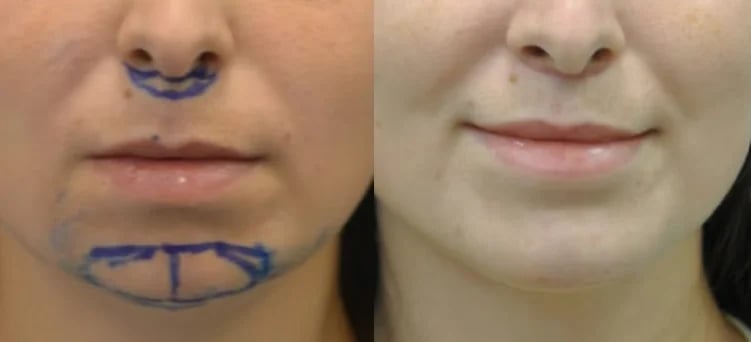
One of the more counterintuitive things patients discover after chin augmentation is how much it changes their perception of features they didn't actually touch. A stronger chin often makes the nose look more proportionate without a single change to the nose itself, and a well-projected chin frequently makes the neck and jawline look tighter and more defined even without any direct treatment to that area. This is because facial features are read relationally, not in isolation - improving one anchor point changes the visual balance of everything around it.
This is also why chin augmentation is frequently discussed alongside - and sometimes instead of - a neck-focused procedure. If you're evaluating options for a heavier-looking neck or jawline, it's worth understanding how chin projection interacts with neck appearance before assuming a neck lift or fat removal is the only answer; for some patients, chin augmentation alone achieves much of what they were hoping a neck procedure would deliver.
Combining Chin Augmentation With Other Procedures
Chin augmentation is frequently performed alongside buccal fat removal for a more sculpted, defined lower face, alongside Kybella or submental liposuction to address both chin projection and neck fullness in a single visit, or as part of a broader facelift and neck lift plan for patients addressing multiple age-related facial changes at once. Combining procedures where clinically appropriate is often more efficient - one recovery period rather than several - and allows Dr. Kirwan to plan the overall facial balance holistically rather than treating each area in isolation.
Risks and Honest Considerations
As with any implant-based procedure, risks include infection, implant malposition or shifting, asymmetry, and in rare cases, implant extrusion or the need for revision. Choosing the correctly sized and shaped implant during consultation is the single biggest factor in avoiding a result that looks overdone or unnatural - this is an area where more conservative, well-planned augmentation nearly always looks better than an aggressive one, and it's worth discussing directly with Dr. Kirwan if you're unsure how much projection is right for your face.
Frequently Asked Questions
How long does chin augmentation surgery take?
When performed alone, chin augmentation typically takes under an hour. Total time in the surgical facility is longer when combined with other procedures.
Is chin augmentation permanent?
A chin implant is a permanent solution, while injectable filler used for chin augmentation is temporary and requires repeat treatment every several months to maintain the effect.
Will chin augmentation change how my nose looks?
It can, without any direct treatment to the nose. Because facial features are judged relative to each other, increasing chin projection often makes the nose appear more proportionate to the rest of the face.
How much does chin augmentation cost?
Cost depends on the type of augmentation chosen (implant, sliding genioplasty, or filler) and whether it's combined with other procedures. Dr. Kirwan's office provides a specific estimate during consultation based on your individual plan.
Can chin augmentation help with a double chin or neck fullness?
In some cases, yes. A recessed chin can make submental fullness look more pronounced than it actually is, so increasing chin projection sometimes meaningfully improves the appearance of the neck and jawline without a separate neck procedure.
Call Our Office For More Information
Share this Article

Dr. Laurence Kirwan
Dr. Laurence Kirwan, MD, FRCS, FACS, is an internationally renowned, board-certified plastic surgeon with over 30 years of experience. He trained at Manchester University and completed his Plastic Surgery residency at the University of Missouri. A Fellow of the Royal College of Surgeons and American College of Surgeons, he is a leader in aesthetic surgery, specializing in face, breast, and body procedures. Dr. Kirwan has authored multiple scientific papers and books and served as an instructor in prestigious programs. Recognized by Tatler and Russian Vogue, he practices in Connecticut, where he continues to offer personalized, top-tier care to his patients.