
04
Aug
Everyday habits that could be causing your breasts to sag
The Dynamic Troika
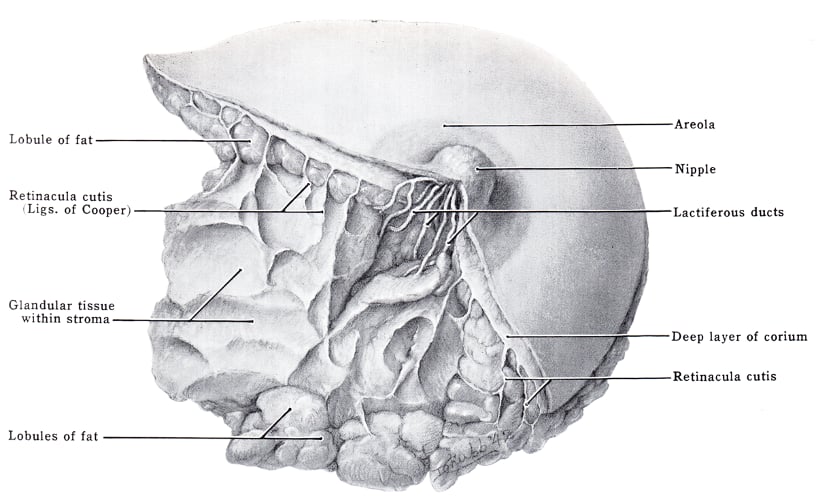
Breast shape is the end result of a delicate balance of forces between a dynamic troika of structural supports. The troika are Cooper’s ligaments, the firm youthful breast tissue between them, and the enveloping skin “brassiere.” Breasts are suspended from the chest wall by “guy ropes” known as Cooper’s ligaments. These are strong, flexible connective tissue bands - not tendons, which connect muscle to bone - that travel through the breast gland, or parenchyma, and attach to the undersurface of the skin. They sit throughout the breast tissue itself, not in one single location, which is why no single exercise or posture change can target them directly.
A youthful, perky breast possesses all three elements of the dynamic troika: tight Cooper’s ligaments, firm parenchyma between them, and a skin layer rich in supportive collagen and elastin fibers. The three elements - Cooper’s ligaments, breast parenchyma, and skin - dynamically support the breast together. A failure of any one of the three breaks the balance and can result in a flat or saggy breast. Unfortunately, this is a common event, and once these ligaments stretch, they do not shorten or tighten back down on their own. For the record, exercises such as push-ups do not strengthen Cooper’s ligaments or lift the breast - they build the chest muscle underneath the breast, which is a different structure entirely. Patients who want to understand their own anatomy in more detail, or explore what a breast lift can and can’t restore, can see real before-and-after results in our gallery. (Structural overview source: Cooper’s ligaments - Wikipedia)
These are the everyday causes of breast sag.
1. Yo-yo weight changes and Weight Loss Transformations*
Weight gain and weight loss affect all three elements of the troika. The greater the difference between maximum and minimum weights, the greater the effect. Weight gain stretches the structural supports of Cooper’s Ligaments and the skin, depleting elastic fibers and collagen. Significant weight loss occurs in the presence of these impaired structural elements so that the breast is unable to ‘bounce-back’ and is no longer supported and consequently sags. Weight loss also causes atrophy of the breast parenchyma. It’s a triple whammy.
2. Running
Running is often blamed for breast sagging. The obvious up and down motion will stretch Cooper’s ligaments. However, I believe that a lot of runners are also anorexic and have a weight below their ideal BMI. Running is such an easy endorphin-primed way to lose weight that runners get addicted. I know. I used to be one. That is, until my knees started screaming their objection. Whatever the underlying process, running can lead to a loss of facial and upper body fat and muscle and selective upper body weight loss with the same changes we see with generalized weight loss.
3. Pregnancy
Pregnancy is not an everyday cause of breast sag, but it is one of the most common causes. There is the associated weight gain, enlargement and then shrinking of breast parenchyma, stretching of Cooper’s Ligaments and relaxation of collagen and elastin in the skin and subcutaneous tissues. In other words, the ‘Full Monty’. However, pregnancy alone, seems to primarily lead to deflation of the breast due to the loss of parenchymal volume. the deflation causes some sag but not to the degree associated with loss of the other structural elements.
4. Breast Feeding
Breast feeding is not an everyday cause of breast sag, but again like pregnancy, it is one of the most common. Breast feeding causes enlargement and stretching of the structural elements that support the breast. When breast feeding ceases, all these elements try to return to their pre-pregnancy condition with varying degree of success. The parenchyma tends to overshoot and lose volume as compared to its pre-pregnancy size. I think it is reasonable to assume that the longer you breast feed, the more profound and permanent will be the changes to the breast. Breast feeding like pregnancy, seems to result primarily in deflation of the breast.
5. Smoking
Smoking accelerates the breakdown of collagen and elastin - the same fibers that give Cooper’s ligaments and breast skin their structure and spring. Nicotine also reduces blood flow to the skin, which slows the skin’s ability to repair and renew itself. The longer the history of smoking, the more pronounced the effect on breast shape over time, independent of weight change.
6. Unsupportive Bras During Exercise
During any activity with repetitive up-and-down motion - running, jumping, high-impact sports - the breast moves independently of the body if it isn’t properly supported. That repeated motion places direct, repetitive strain on Cooper’s ligaments specifically, since they are the structures absorbing the bounce. A properly fitted, supportive sports bra reduces this motion substantially and is one of the few genuinely preventive steps available before any structural changes occur.
7. Sun Exposure
Breast skin is thinner and more sun-sensitive than most people assume, and it is rarely protected with sunscreen the way facial skin is. UV exposure breaks down collagen and elastin in the skin layer of the troika, accelerating the same loss of elasticity that occurs naturally with age. This is particularly relevant for patients who sunbathe or wear low-cut clothing regularly without SPF underneath.
8. Poor Posture
Chronic slouching changes the resting position of the breast on the chest wall over time and places the skin and ligament structures under uneven, sustained tension rather than the more even support they get in an upright posture. This is a slower-acting cause than the others, but a cumulative one.
*Weight loss transformations is defined as the patient having lost 50% of their weight in excess of their ideal BMI
Frequently Asked Questions
What is Cooper’s ligament?
Cooper’s ligaments are the strong, flexible connective tissue bands that support the breast. They run through the breast tissue itself and attach to the underside of the skin, functioning like internal “guy ropes” that help hold the breast’s shape against gravity. If you’re considering surgical options for restoring shape, our breast lift / auto-augmentation page covers how that procedure works with the breast’s own tissue.
Where are Cooper’s ligaments located?
They’re distributed throughout the breast tissue rather than sitting in one place - running from deep in the chest wall, through the breast parenchyma, to the underside of the skin. This is why sagging tends to develop gradually and unevenly rather than at a single point.
Can Cooper’s ligaments be strengthened or tightened?
No. Cooper’s ligaments are connective tissue, not muscle, so they can’t be exercised or strengthened the way muscle can. Once they’ve stretched, they stay stretched. This is why exercises like push-ups or chest presses - which build the pectoral muscle beneath the breast - don’t reverse sagging, even though they’re often recommended for that purpose. The only way to restore lift once the ligaments have stretched is surgically; see breast lift for how that’s approached here.
What is Cooper’s droop?
“Cooper’s droop” is a term used to describe breast sagging that results specifically from the stretching or failure of Cooper’s ligaments, as opposed to sag caused primarily by loss of breast volume alone.
Does exercise help prevent sagging breasts?
Wearing proper support during high-impact exercise helps reduce the repetitive strain that contributes to ligament stretching, but exercise itself does not strengthen the ligaments or reverse existing sag. Its main protective value is prevention, not correction.
Does breastfeeding cause breasts to sag?
Breastfeeding isn’t an everyday cause of sag, but it’s one of the most common ones. It stretches the same structural elements affected by pregnancy, and breast tissue often doesn’t fully return to its pre-pregnancy volume afterward, leading to a deflated, sagging appearance. Patients exploring options after pregnancy or breastfeeding often ask about a mommy makeover, which typically addresses both the shape change and volume loss together.
What causes breasts to sag the most?
There’s rarely a single cause. Sagging is usually the cumulative result of several factors acting on the same three structures: weight changes, pregnancy and breastfeeding, smoking, sun exposure, and repetitive strain without support all affect Cooper’s ligaments, breast tissue, or skin elasticity, often in combination.
Are ligaments and tendons in the breast the same thing?
No. Ligaments connect one structure to another - in the breast, Cooper’s ligaments connect the breast tissue to the overlying skin. Tendons, by contrast, connect muscle to bone and aren’t part of the breast’s support structure at all. When people search for “breast ligaments and tendons,” they’re usually asking about Cooper’s ligaments specifically, since that’s the only connective structure that determines breast shape.
Can Cooper’s ligaments be strained or injured?
Cooper’s ligaments can be stretched by repetitive strain, sudden weight change, or trauma, but this isn’t the same as a muscle or joint ligament strain with acute pain. The change is usually gradual and shows up as a change in breast shape or position over time rather than as a sudden, painful injury.
Are Cooper’s ligaments the same as the suspensory ligaments of the breast?
Yes - “Cooper’s ligaments” and “suspensory ligaments of the breast” refer to the same structures. Cooper’s ligaments is simply the more common clinical name, after the surgeon who first described them.
Why do breasts sag as you get older, separate from weight or pregnancy?
Age-related sag happens even without the other causes listed above, because collagen and elastin production in the skin naturally declines over time, and Cooper’s ligaments slowly lose elasticity the same way skin elsewhere on the body does. It’s the same tissue-aging process seen in facial skin, just less commonly discussed. For patients whose main concern is age-related change rather than a specific cause, a breast lift is generally the most direct option; for volume loss specifically, breast augmentation or implant-alternative approaches may be more relevant.
How can I tell if my Cooper’s ligaments have already stretched?
The clearest sign is a change in where the breast sits on the chest relative to the crease underneath it - if the nipple has moved lower relative to that crease over time, that’s typically ligament and skin laxity rather than volume loss alone. This is something best assessed in person; a consultation can determine which of the three structures (ligaments, tissue volume, or skin) is driving the change in your specific case.
Schedule a Consultation
Call for an appointment and a consultation with Dr. Kirwan.
Conveniently Located: Every patient is a VIP. Our Norwalk, CT location is conveniently located in between Manhattan, New York and New Haven, Connecticut. Patients regularly visit from across Connecticut (Stamford, Greenwich, Stratford, Fairfield, Westport, Bridgeport, Darien, New Canaan, Trumbull), New York ( Manhattan, NYC, Larchmont, Mamaroneck, New Rochelle, Port Chester, White Plains, Harrison), New Jersey and other neighboring cities/towns. Our office is close to all of the New York Airports for patients who are coming from out-of-state or other countries.
Call Our Office For More Information
Share this Article

Dr. Laurence Kirwan
Dr. Laurence Kirwan, MD, FRCS, FACS, is an internationally renowned, board-certified plastic surgeon with over 30 years of experience. He trained at Manchester University and completed his Plastic Surgery residency at the University of Missouri. A Fellow of the Royal College of Surgeons and American College of Surgeons, he is a leader in aesthetic surgery, specializing in face, breast, and body procedures. Dr. Kirwan has authored multiple scientific papers and books and served as an instructor in prestigious programs. Recognized by Tatler and Russian Vogue, he practices in Connecticut, where he continues to offer personalized, top-tier care to his patients.